Upholstery care
How to Clean an Upholstered Headboard Without Damaging the Fabric
A headboard gets a very specific kind of soiling: a band of hair product and body oil at pillow height, plus fine dust everywhere else. Because the panel is vertical and often not removable, the risk is not soil — it is streaking and water marks from cleaning it badly.
By Go4Cleaning Team · Updated August 26, 2026 · 6 min read
Quick answer
Vacuum an upholstered headboard from top to bottom first to remove dust and hair, then treat the oil band near pillow height with a small amount of cleaner suited to the fabric's cleaning code, applied to a cloth rather than sprayed directly. Work the whole panel evenly and dry with airflow to avoid streaking or water rings on the vertical surface.

Start dry, and start from the top
- Pull the bed away from the wall so you can reach the back edge and the gap behind.
- Vacuum the whole panel with an upholstery tool, working top to bottom.
- Use a crevice tool along buttons, tufting and the seam where the panel meets the frame.
- Take bedding off first — anything you release lands on it otherwise.
The oil band needs different treatment to the dust
Hair oil is greasy, so a water-only wipe just spreads it. On a W or WS fabric, a pH-neutral upholstery cleaner applied to a white cloth — not sprayed onto the panel — lifts it with far less moisture.
Work the whole panel section rather than a single spot. Cleaning one patch of a vertical fabric is how you end up with an obvious clean rectangle.
Avoiding water marks on a vertical panel
- Never spray directly; gravity pulls the liquid down and dries it into a tide line.
- Keep the cloth damp, not wet, and work edge to edge.
- Feather the edges of each pass so there is no hard boundary.
- Put a fan on it afterwards so the fabric dries evenly rather than from the bottom up.
Velvet, linen and X-code panels
Velvet crushes and linen watermarks easily, and both punish home experiments. On these we use low-moisture methods with fast air drying, and we groom the nap afterwards.
If the tag reads X, the honest answer is that it should be vacuumed only. We will not wet-clean it just to book the job.
Keeping it clean between visits
Vacuum the headboard when you change the sheets, and keep hair products off the panel where you can. A washable throw across the top edge is unglamorous but it keeps the oil band from forming at all.
Background from the original guide
A headboard sits right where your head, hair, and hands rest every night. Skin oils, grease from hair products, and general dirt constantly transfer onto the fabric. Over time, this creates a buildup that a regular dusting simply cannot fix.
Dust also settles deep into the upholstery fibers, and if left too long, it becomes embedded and harder to remove. Think of your headboard as a soft surface that traps everything around your bed frame and mattress area.
What You Will Need Before You Start
Gathering your supplies in advance makes the whole process smoother. Here is what you should have on hand:
Avoid harsh chemical cleaners unless your upholstery care tag specifically allows them. When in doubt, less is more.
Step 1 — Always Do a Spot Test First
Before applying anything to the full surface, do a spot test on a hidden corner of the fabric. Apply a small amount of your cleaning solution and wait a few minutes to see how the textile reacts. This simple step can save your headboard from permanent damage.
Vacuuming safely
Use your vacuum cleaner with the brush attachment to go over the entire headboard. Work in slow, overlapping strokes to lift dust, debris, and loose dirt from the upholstery fibers. Pay attention to seams and tufted areas where buildup tends to hide.
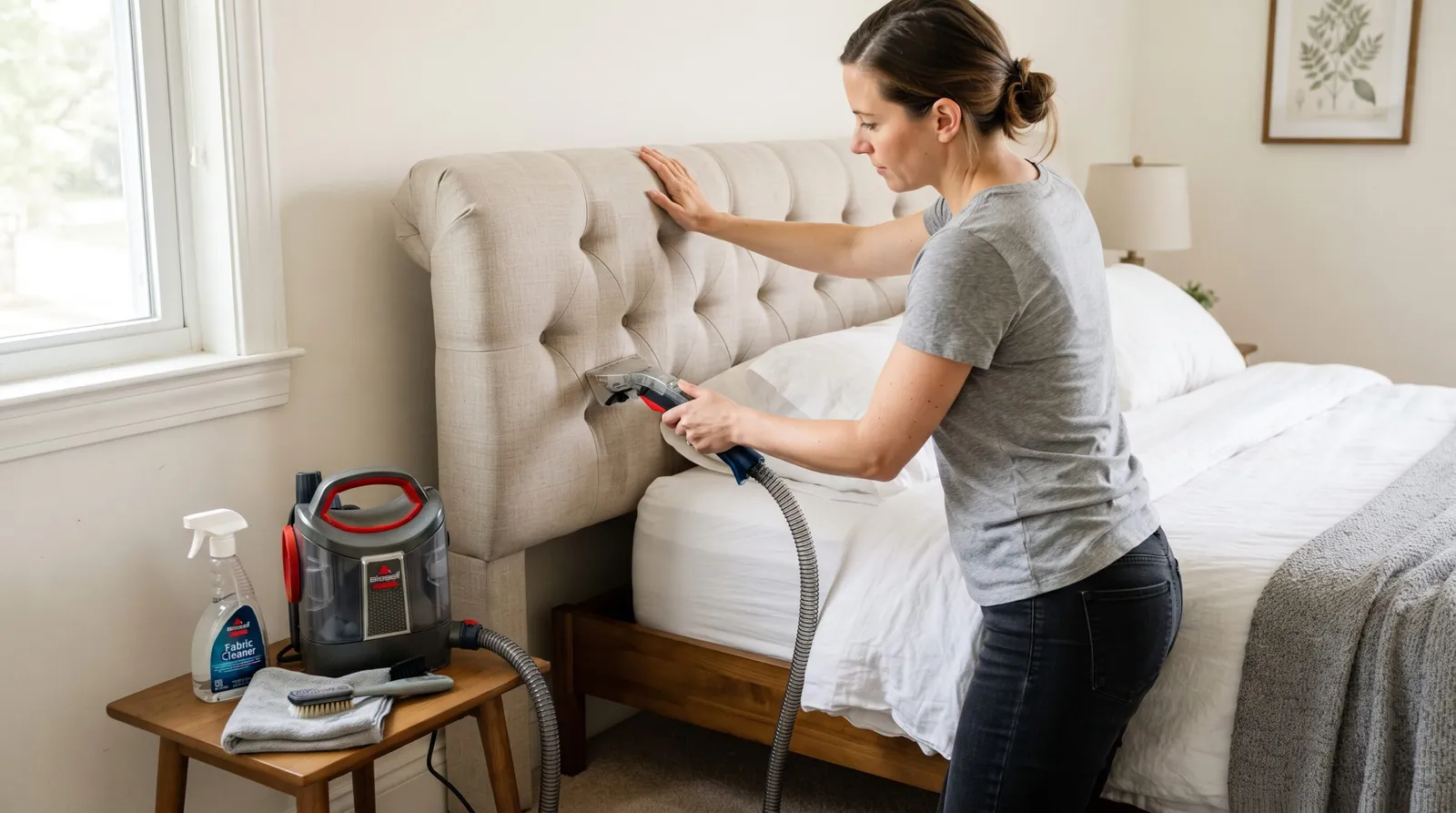
Use a clean upholstery attachment with light suction if the label allows vacuuming, working slowly in overlapping strokes and paying attention to seams, buttons and tufting where debris settles.
Removing dry soil first matters: adding moisture to loose dirt simply turns it into a smear that is harder to lift.
Step 3 — Mix a Gentle Cleaning Solution
Combine a few drops of dishwashing liquid with warm water in your spray bottle. This mild soap solution works well on most fabric types without stripping the fibers.
Step 4 — Clean the Fabric With a Microfiber Cloth
Lightly mist your microfiber cloth with the solution — do not soak it. Gently blot and wipe the headboard surface in small sections. Avoid rubbing aggressively, as that can push the stain deeper or damage the fabric weave.
For stubborn stain removal, use a soft brush in gentle circular motions after applying the solution. Let it sit for a minute or two, then blot clean.
Step 5 — Tackle Odors With Sodium Bicarbonate
If your headboard has a musty smell, lightly sprinkle sodium bicarbonate over the surface and let it sit for 15 to 20 minutes. Then vacuum it away thoroughly.
Drying and residue
Use a dry microfiber cloth to absorb excess moisture. Then allow the headboard to air dry completely before putting pillows back against it. Using a fan or opening a window speeds up the process.
Where the label permits water-based cleaning, keep the cloth barely damp rather than wet, and work in small sections with blotting motions instead of vigorous scrubbing, which distorts the weave and drives soil deeper.
Finish by blotting with a dry microfibre cloth and letting the headboard dry fully before pillows go back against it. Good airflow from an open window or a fan across the room speeds that up.
Steam and hot-water cleaning
If your headboard is leather rather than fabric, skip the soap-and-water approach entirely. Leather requires a dedicated leather cleaner and conditioner to avoid cracking or staining. For deep cleaning, steam can be highly effective on fabric upholstery. However, steam is best used carefully and is often more appropriate for professional upholstery cleaning services.
A leather headboard is a different job: it should be cleaned with a product made for leather and conditioned afterwards, not with soap and water.
Steam can loosen embedded soil, but heat and moisture also damage delicate fabrics, adhesives and padding. If the fabric is delicate, the staining is extensive, or an odour will not lift, professional upholstery cleaning is the safer route.
Why upholstered headboards get dirty quickly
A headboard sits directly behind your head and shoulders, so it collects skin and hair oils night after night, along with hair products, perspiration and everyday dust.
Upholstery traps that build-up more readily than a hard surface, so occasional dusting rarely keeps up. Over time the fabric can look flat or discoloured compared with the rest of the room.
Check the cleaning code first
Check the manufacturer's care label before anything else, and follow it — it tells you whether water-based cleaning is appropriate at all.
Then test whatever you plan to use on a hidden area such as the back or a lower corner. Apply a small amount, wait a few minutes and look for colour change, fading or a texture shift before going near the visible face.
Related service
Upholstery cleaningFamily-owned, based in Beverly Hills, serving Los Angeles County and approved Orange County communities.
Recent Go4Cleaning work
Photos from Go4Cleaning jobs, taken by our own crew.
Common questions
Can I use a steam cleaner on a headboard?
We would not, at home. Steam adds heat and moisture to a vertical panel that cannot be removed and dried flat, which is the recipe for marks and crushed nap.
Do you clean headboards as part of an upholstery visit?
Yes. It is normally added to a sofa or mattress job in the same visit, since the equipment is already set up.
Want this handled properly?
Call or text (866) 631-2244 for a straightforward quote, or send photos with your request.
Cleaning appointments 8:00 a.m. – 8:00 p.m. daily. Calls, messages and scheduling 24/7.