Upholstery care
How to Remove Pen Ink From a Couch Without Damaging the Fabric
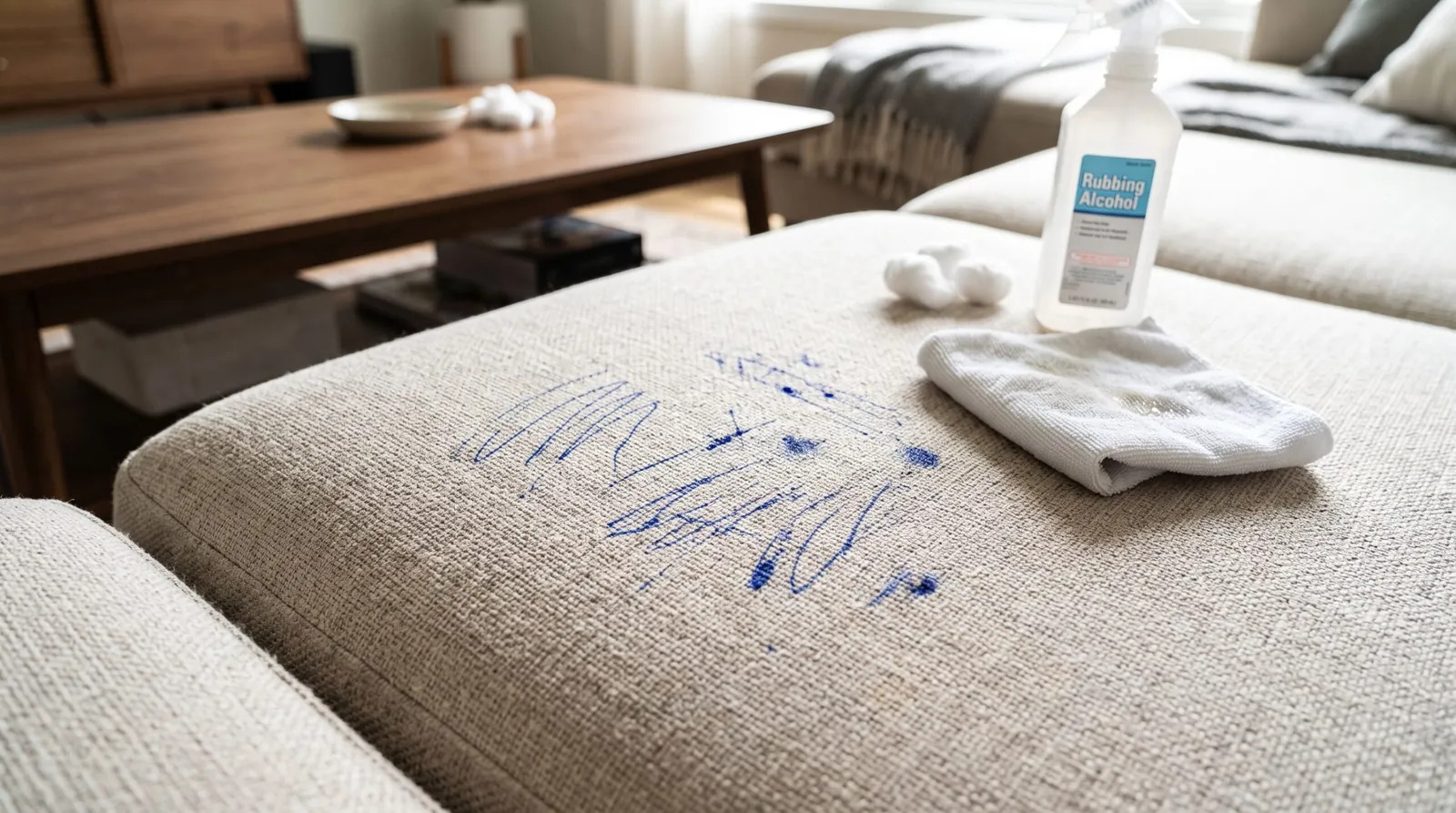
Ink is a dye in a carrier. Most home remedies dissolve the carrier — which is why the mark gets bigger before it gets smaller — and some strip the fabric's own colour along with the ink. Slow and small beats fast and confident here.
By Go4Cleaning Team · Updated August 26, 2026 · 5 min read
Quick answer
Blot ink immediately with a dry cloth working from the outside of the mark inward, and check the fabric's cleaning code before applying anything liquid. Use only a cleaning product labeled for that specific fabric type, test it on a hidden seam first, and stop if color starts transferring to your cloth — at that point a professional spot-cleaning assessment is the safer next step, since full removal isn't guaranteed.
First rule: contain it, do not chase it
- Blot excess ink with a dry white cloth, pressing straight down. No wiping.
- Work from the outside of the mark inward so you are not pushing the edge outward.
- Change to a clean part of the cloth constantly — a loaded cloth just redeposits ink.
- Check the cleaning code before any liquid touches the fabric.
Why generic home remedies are risky
- Household solvents like rubbing alcohol, hairspray and hand sanitiser are not formulated for upholstery and can lift a fabric's own dye along with the ink, or leave a sticky residue that attracts soil.
- Bleach or oxygen-based cleaners do not remove ink at all — they remove colour, leaving a permanent light patch where the stain was.
- Gel and permanent-marker ink behave differently to ballpoint and often resist home treatment completely.
What is reasonable to try before calling a professional
- Check the cleaning code on the tag — it tells you whether water-based or solvent-based products are appropriate for that fabric at all.
- Choose a cleaning product labeled specifically for upholstery or that fabric type, and follow the label instructions exactly rather than mixing your own solution.
- Test it on an unseen seam first and let it dry fully before judging whether the colour holds.
- Blot gently with a clean section of cloth each time rather than scrubbing or soaking the area.
- Stop if colour starts transferring to your cloth or the mark spreads — that is the point to get a professional assessment rather than keep working the spot.
How professional spot work differs
We match the solvent to both the ink type and the fibre, work in small controlled amounts, and extract the residue rather than letting it dry in place. That control is the difference between a smaller mark and a spreading halo.
We will not promise complete removal. Some inks bond to synthetic fibres permanently, and some fabrics have already been bleached by an earlier home attempt. We tell you the likely outcome before we start.
When to stop and call
Stop if the mark is spreading, if colour is transferring onto your cloth, or if the fabric is coded S or X. Every extra pass at that point is making the professional job harder and the outcome worse.
Background from the original guide
Not all ink is created equal. A ballpoint pen uses an oil-based ink that tends to sit on top of fibers at first, while a gel pen uses a water-based pigment that absorbs quickly into the textile. This difference matters because it affects which cleaning agent will actually work.
Fabric type also plays a huge role. Microfiber, for example, is one of the most common couch materials in modern homes, and it responds very differently to water versus solvent-based cleaners. Using the wrong product on the wrong textile can cause fading, shrinking, or permanent staining.
Check the cleaning code first
Before you apply anything to your couch, look for the manufacturer’s tag. It will typically show one of these codes:
W — Water-based cleaners are safe to use
W/S — Both water and solvents are safe
X — Vacuum only; no liquids at all
This single step can save you from damaging your fabric. If your couch is coded “S” or “X,” skip any water-based solutions entirely.
Treating spills and stains
Some instincts are actually counterproductive when it comes to stain removal. Here are the biggest mistakes people make:
Rubbing aggressively — This spreads the ink and drives it deeper into the fabric
Using hot water — Heat can permanently set an ink stain into textile fibers
Soaking the area — Over-wetting can lead to mold, watermarks, or damage to the cushion filling
Tossing a couch cushion in the washing machine — Unless the care tag specifically allows it, this can warp or shrink the cover
Tips Specific to Microfiber Couches
Microfiber is a popular choice for Los Angeles households because it is soft, durable, and relatively easy to maintain. But it requires special attention when dealing with ink.
For microfiber, isopropyl alcohol is generally the safest choice. Apply it with a white sponge or cloth, blot the stain, and then use a soft-bristled brush to restore the nap of the fabric once it dries.
Avoid water unless the tag confirms it is safe — water can leave visible rings on microfiber that are difficult to remove.
When DIY Is Not Enough
Some ink stains are simply beyond what household products can handle. If the stain has dried and set deep into the fabric, or if your couch material is delicate or expensive, a professional cleaning service is the safer choice.
Professional upholstery cleaning uses specialized equipment and solutions that penetrate fabric fibers without causing damage. It is especially worth considering if your couch is a significant investment or if previous DIY attempts have left residue or discoloration.
Related service
Upholstery cleaningFamily-owned, based in Beverly Hills, serving Los Angeles County and approved Orange County communities.
Recent Go4Cleaning work
Photos from Go4Cleaning jobs, taken by our own crew.
Common questions
Can old ink stains still be removed?
Sometimes partially. Fresh ink responds far better; ink that has been through months of sunlight and body heat often will not fully release.
Will cleaning the whole cushion hide the mark?
It can help the area blend by removing the surrounding soil, and it is often part of what we do, but it is not a substitute for spot work.
Want this handled properly?
Call or text (866) 631-2244 for a straightforward quote, or send photos with your request.
Cleaning appointments 8:00 a.m. – 8:00 p.m. daily. Calls, messages and scheduling 24/7.